Random words make good game material because nobody at the table gets to choose the easy answer. They can turn into a story, a drawing, a clue, or a quick vocabulary challenge. Most of the activities below work with two people, a classroom, or a larger group.
Get the game piecesGenerate a fresh set of random words→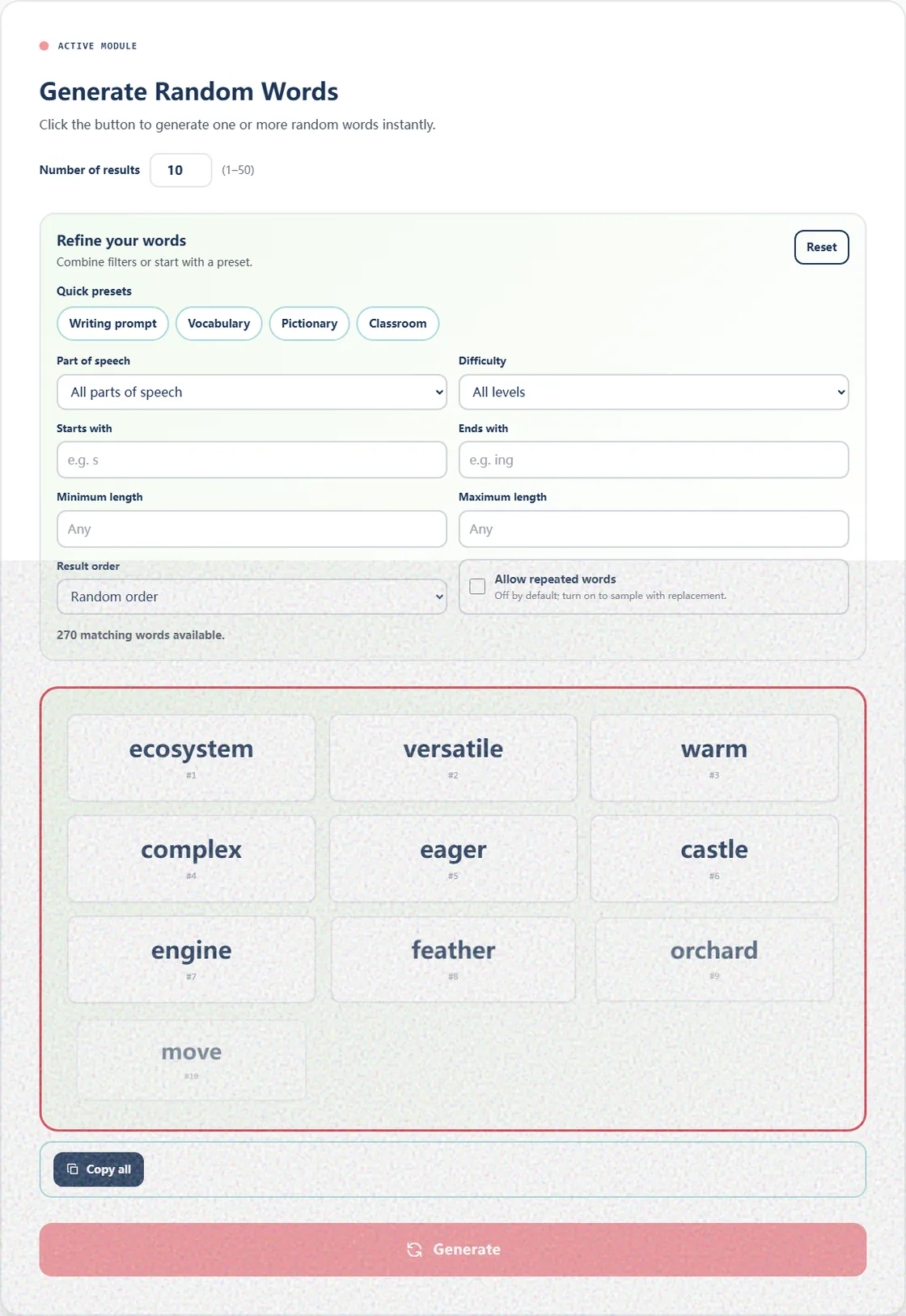
Set up a useful word list
Start with five to ten words. For a younger group, select common words. Writers may prefer a mix of nouns, verbs, and adjectives. The generator also lets you sort the result or keep the original random order. Leave replacement off when you do not want duplicate words in the same round.
Seven games to try
1. Draw and guess
Best for: families, classrooms, and parties.
One player secretly takes a word and draws it without writing letters or numbers. The first correct guess earns a point. Use nouns for an easier round; use verbs or adjectives when the group wants a stranger challenge.
2. One-word-at-a-time story
Best for: warm-ups and creative groups.
Generate eight words and read them aloud. Players build one shared story, adding only one sentence per turn. A generated word must appear in every sentence. The story often changes direction just when somebody thinks they control it.
3. The three-word bridge
Best for: writers and brainstorming sessions.
Choose three unrelated words. Everyone has five minutes to connect all three in a scene, product idea, character, or short pitch. Compare how many different bridges the group found.
4. Describe it, do not say it
Best for: speaking and vocabulary practice.
A player explains a word without using the word itself, a direct translation, or the first letter. Set a 30-second timer. For a harder version, ban two obvious clue words before the round starts.
5. Find the intruder
Best for: classrooms and reasoning practice.
Generate five words. One person secretly chooses the word that “does not belong” and explains the rule only after others guess. There may be several defensible answers, which is what makes the discussion useful.
6. Vocabulary sprint
Best for: language learners.
Give each player one minute to define a word, use it in a natural sentence, name a synonym, and draw a tiny memory cue. Use the common difficulty first, then move to advanced words.
7. Headline machine
Best for: writers, marketing teams, and silly evenings.
Generate one noun, one verb, and one adjective. Turn them into the headline of an imaginary news story. Then write the opening sentence. Award points for the clearest, funniest, or most surprising version.
Make the game fit the group
- Use three words instead of ten when attention is more important than variety.
- Choose common words for speed and advanced words for discussion.
- Let players skip one word without losing a turn.
- Play cooperatively by trying to use the whole list before time runs out.
- Copy the generated list into a shared document when playing remotely.
For a game based on physical things rather than vocabulary, try the Random Object Generator. It works well for drawing rounds, scavenger-hunt ideas, and improvised stories.
Start a roundChoose your word type and generate the list→